
Russell County Parole vs Probation
Parole and probation both place a released person under rules, but they come from different events. Parole usually follows a state-prison sentence. The person leaves physical prison custody before the sentence is fully discharged and reports under the Alabama Bureau of Pardons and Paroles. Probation usually comes from a court sentence. A Russell County court may order probation instead of jail, after a split sentence, or after part of a sentence has been served.
The difference matters because the Russell County Sheriff's In Custody Search is not a supervision list. It can help confirm whether someone is still visible in current jail custody. Once release occurs, supervision must be verified through the sentencing court, the Alabama Bureau of Pardons and Paroles, the Phenix City Field Office, or notification systems such as VINELink Alabama and Alabama VNS when the custody type is covered.
| Supervision type | Where it comes from | Russell County verification path |
|---|---|---|
| Parole | Board action after a state-prison sentence reaches parole consideration. | ABPP hearing schedule, parole results, VNS or VINE notice, and the local ABPP field office. |
| Probation | A Russell County court order, plea, sentence, split sentence, or revocation order. | Russell County court records, case-action summaries, and ABPP if the case is supervised by that agency. |
| Discharge | Completion of the custody or supervision term. | Court record, ABPP record, or ADOC public-record request depending on the sentence source. |
- Parole
- Conditional release from state prison before the sentence is fully complete, subject to Board rules.
- Probation
- Court-ordered supervision in the community, often tied to a sentence, plea, or split sentence.
- Absconder
- A supervised person who is alleged to have stopped reporting or whose location is unknown to the supervising authority.
- Discharge
- The end of a sentence or supervision term, not just the day physical custody ended.
Verify Russell County Supervision
The most reliable first step is to decide whether the person was a county-jail detainee, an ADOC prisoner, or a person sentenced by a Russell County court. A bond release from the Russell County Jail is not parole. A state-prison release may be parole, mandatory supervision, or discharge. A court sentence may show probation even if the person never entered ADOC custody. The Russell County Circuit Court and AlaCourt public access can show the case action that created probation, revocation, dismissal, or sentence completion.
- Search the Russell County Sheriff's current-custody feed first if the release is recent. If the person is still listed, the supervision question may not be ripe yet.
- Check the Russell County court case for a probation order, split sentence, revocation, commitment to ADOC, or disposition that explains the release path.
- Use ABPP sources when the person had a state sentence, a parole hearing, mandatory supervision, or a probation case supervised by the state agency.
- Review scheduled parole hearings and current-year parole results if parole consideration is the issue.
- Contact the Phenix City Field Office only for appropriate public supervision questions. It is not a general released-inmate roster.
A parole eligibility date is not the same as release. ABPP says eligibility consideration is calculated under Ala. Code Section 15-22-28(e), and sentence, offense, jail credit, good-time eligibility, time served, and court orders can affect the date. A hearing can still end in a grant, denial, or continuance. For the broader release-record path after a jail stay, use the Russell County released-inmates hub at index.html.
Note: A missing jail-roster entry can mean release, transfer, data lag, or another custody route.
Russell County Field Office
Russell County has a specific local supervision office. The ABPP Phenix City Field Office is the local contact named for Russell County supervision in the research sources, which makes it more useful than a statewide switchboard for many post-release questions. The office's published hours use Eastern Time, a local detail worth preserving because Phenix City sits on the Alabama-Georgia border and state agencies elsewhere in Alabama may use Central Time.
The ABPP Phenix City Field Office page lists the office as serving Russell County. Use it for parole or probation supervision routing after the court or ADOC path shows that ABPP is involved. Do not use it to confirm every bond release from Russell County Jail, because a person released before conviction may have no ABPP supervision at all.
Alabama Bureau of Pardons and Paroles, Phenix City Field Office1521 5th Avenue
Phenix City, AL 36867
Phone: 334-298-6521
Fax: 334-291-3392
Hours: Monday-Friday, 8:00 A.M.-5:00 P.M. EST; closed noon-1:00 P.M. EST and state/federal holidays
The office does not replace the court file. If the Russell County case involved probation, the court order remains the source for the sentence terms, start date, revocation history, and discharge event. If the person was released from ADOC to parole or supervision, ABPP records and the field office explain the supervision side while ADOC and VNS explain custody processing.
The ABPP Phenix City Field Office source is shown below because it is the local Russell County supervision office rather than a generic statewide page.
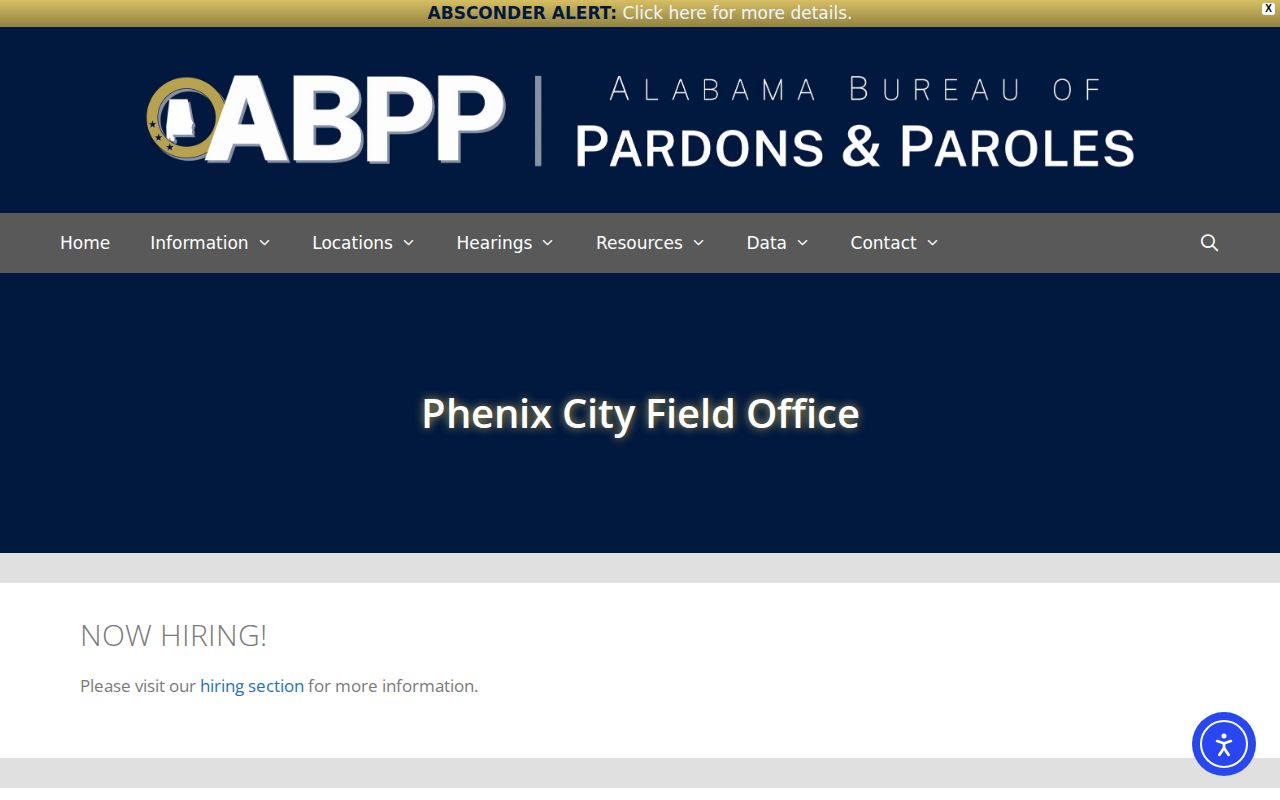
The office details support the local verification route: confirm that ABPP is the supervising agency, then use the listed Phenix City office for supervision-specific questions.
Russell County Parole Hearings
Parole hearings are a separate stage from jail release. The Alabama Board of Pardons and Paroles publishes a scheduled hearing calendar and current-year results. The general hearing information source says parole and pardon hearings are held in open public meetings each week on Tuesday, Wednesday, and Thursday unless noted, at the Montgomery ABPP location. Results posts can report grants, denials, and continuances.
For a Russell County person in ADOC custody, a scheduled hearing means the Board is considering parole. It does not mean the person has been released. A grant is a strong sign of a release path, but the actual date can still depend on ADOC processing, required notice, conditions, detainers, and the assigned supervision office. A denial means there was no parole release from that hearing. A continuance means the decision moved to another date or setting.
| ABPP source | What it can show | What it does not prove |
|---|---|---|
| Scheduled hearings | That the Board has placed the person on a hearing calendar. | That release has been granted or processed. |
| Current-year results | Grant, denial, continuance, or related Board outcome when posted. | The full release record, jail destination, or all supervision terms. |
| Results archive | Older hearing-result posts and public Board action summaries. | A live custody status for a person just processed by ADOC. |
Russell County Violations and Warrants
Supervision conditions are the rules a released person must follow. They can include reporting, travel limits, treatment, payments, no-contact orders, or court-specific terms. The exact terms come from the court order, parole certificate, probation order, or ABPP instructions. A public page should not infer a violation from a missing roster record. Missing from the jail feed only means the person is not visible in that current-custody source at that moment.
Absconder and warrant status need a named source. The research did not identify a Russell County-specific ABPP absconder list. The sheriff's app manifest includes a Most Wanted feature, but most-wanted notices are not the same thing as a complete probation or parole absconder list. If a warrant or revocation is suspected, check the Russell County court case, sheriff warrant process, or ABPP source rather than treating a rumor or old custody entry as proof.
Russell County Reentry Context
The local jail source includes several custody and reentry-adjacent facts, but they should be framed with care. The Russell County Sheriff's corrections page says the jail offers programs such as GED, parenting and family-planning skills, Alcoholics Anonymous, Narcotics Anonymous, and Bible studies. It also says the jail offers alternatives including work release and work crew programs. These facts help explain the local custody setting, not the outcome for any one released person.
Program participation is not a public release-confirmation method. A person may have been in a program and still have a pending case, a hold, a transfer, or no ABPP supervision. For release verification, use the jail record, court file, ABPP supervision path, VINELink or Alabama VNS where covered, and ADOC records for state-prison custody. For program or work-release details, use the Russell County Sheriff's corrections page or contact the jail through official channels.
Note: Jail programs can explain local custody options, but they do not prove parole, probation, or discharge.
Russell County Supervision Discharge
Supervision ends through discharge, court action, sentence expiration, revocation, or another formal order. A discharge is different from a physical release from jail or prison. It means the supervision term itself has ended. For probation, the Russell County court record is often the durable source because it can show the original sentence, revocation history, amended orders, and termination. For parole or state supervision, ABPP and ADOC records may be needed.
Alabama public-record law matters, but it has limits. Ala. Code Section 36-12-40 gives Alabama residents the right to inspect and copy public records unless a law provides otherwise, and Section 36-12-41 addresses copies on proper request and reasonable fees. Juvenile, sealed, expunged, medical, protected, or security-sensitive records may be withheld or redacted. Ask for the specific supervision or discharge record rather than a broad file when a formal record is needed.
Alabama VNS and VINELink can help with custody-change notice, but they do not replace a court or agency discharge record. The Alabama VNS page is limited to offenders convicted in Alabama and sentenced to prison, and it tells people with pretrial cases to contact the county sheriff. That distinction is central in Russell County because many jail releases are local court or bond events, not state-prison parole events.
Public Record Search
Sponsored Results